
The Second Coming

The price of a contract that pays a dollar if Jesus Christ returns this year is currently trading at about four cents on Polymarket, up from about two cents in early January:
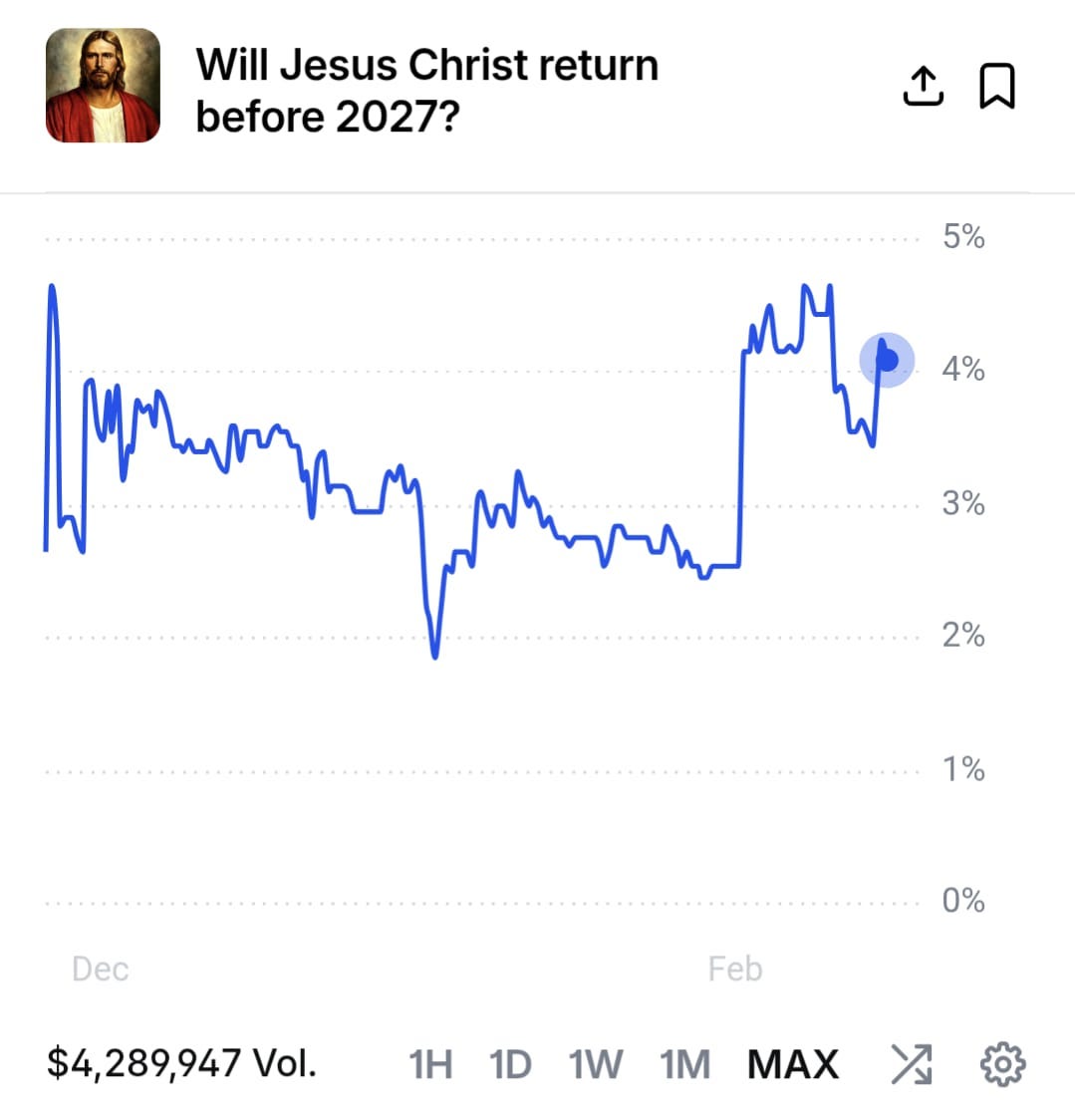
Meanwhile, on a separate market, traders are betting on whether or not the above price will exceed five cents for at least thirty minutes during the one hour window from midnight to 1am ET on February 17. The price of this derivative contract is currently 18 cents, and reached 36 cents at one point:
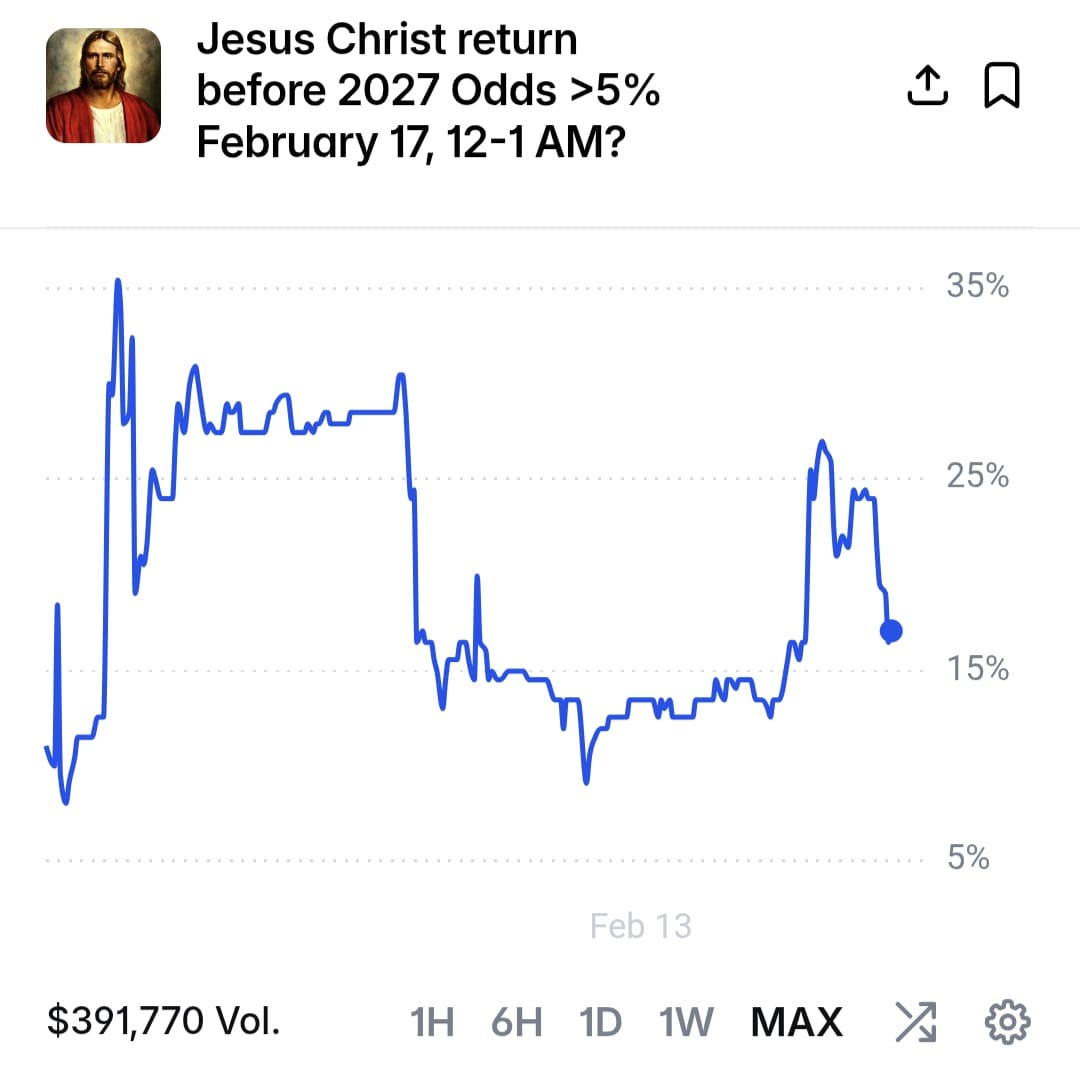
Trading volumes are not small—more than four million contracts have been traded on the former market, and almost 400,000 on the latter. And this is not the first time that the existence of a derivative market has distorted prices in a primary market; I wrote about an earlier incident in September 2004.
I am confident that we will not witness the second coming this year, but am also quite sure that the price on the primary market will indeed reach five cents during the referenced window. Whether it remains there for the required thirty minutes is less certain; that will depend on the outcome of a tug-of-war between the yes and no holders on the derivative market. Either way, volume will be high and prices will hover around five cents before falling once the hour is up.1
The second-highest yes holder in the derivative market, with 10,900 shares to his name, happens to be among the most profitable traders on Polymarket and Kalshi over the past few years:2
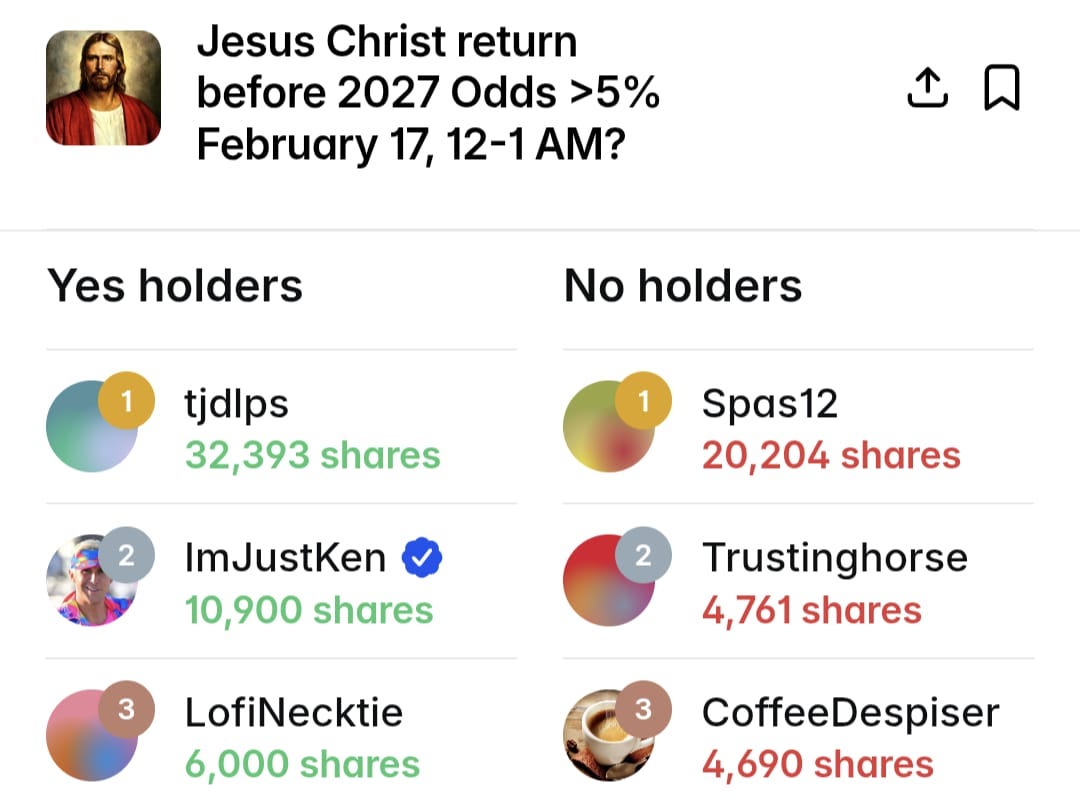
Domer (ImJustKen) is no fool. He can see from the current order book that it would cost less than $45,000 to drive the price to 5.1 cents in the primary market with a single order. Keeping it there for thirty minutes will be harder, as those who stand to lose from this will fight to keep a lid on the price. They will face a major structural disadvantage—at a price of five cents, it will cost 19 times as much to buy a no contract than a yes contract. Whatever the eventual outcome, there will be sharp movements in the secondary market, allowing yes holders to liquidate at a profit.
Notice that these price movements have nothing to do with the aggregation of information or the wisdom of crowds. Most traders understand that the likelihood of a second coming this year is precisely zero. They are trying to out-think each other, each confident that they are smarter and more sophisticated than the average market participant. It’s a Keynesian beauty contest in modern form, a guessing game with more people expecting to win than is mathematically possible.
Prediction markets are effective forecasting mechanisms when history is not a good guide to the future, when we are in uncharted waters. But like all financial markets, they are subject to excess volatility, and this can compromise predictive performance. The presence of markets that reference prices in other markets makes matters considerably worse.
The price in a market referencing the second coming cannot possibly influence the objective probability of the event. But that is not the case for markets referencing elections. Optimism can feed on itself in politics, boosting morale, fundraising, volunteer effort, and turnout. This is especially the case in multi-candidate races when tactical voting becomes a factor.3 The manipulation and distortion of prices in such markets can have real and pernicious effects.
As we approach the midterm elections in the United States, there will be price movements that defy easy explanation. Voters will be left wondering whether markets are revealing information that is largely hidden from view, or whether incentives for manipulation and distortion are making their presence felt. And unlike the case of the second coming, it will not always be an easy call.
That is, I suspect that the best time to bet against the second coming will be between midnight and 1am on the 17th, when the price of the no contract should drop below 95 cents. It ought be possible to sell these shares for a profit shortly afterwards. Update (8am ET on 2/16): The price on the second coming market has now fallen to 3.6, that on the derivative market to 11, and Domer appears to have cashed out his position. Based on current quotes it will cost over $64K to move the price to 5.1 with a single order, so we may never get there. The best time to bet against the second coming may now have passed.
This trader was recently featured in the New York Times, and has cumulative profits of 1.7 million dollars on Kalshi and almost 3 million on Polymarket to date.
Love the resolution rule on The second Coming: "The resolution source for this market will be a consensus of credible sources."
The Second Coming presupposes a First Coming, with consensus among credible sources. The Second Coming also presupposes the absence of a prior Second Coming.
Overall, plenty ways to be legitimately frustrated with the outcome, no matter what it is. I wouldn't be surprised if the market got cancelled.
The question "will Jesus Christ return this year" is open-ended enough that it might actually be difficult to resolve. In the sci-fi novel "Canticle for Leibowitz" for instance, Christ returns in the form of the underdeveloped second head of a mutant tomato seller.
When I first read the book I thought this was pretty weird, but as I understand it the theological argument is that God comes in the most lowly and disreputable form to remind people that true goodness comes from only God. If this is argument is correct, the return of Christ may only be recognized much after the fact.
Not sure how this insight might be monetized on a prediction market.