
A Pincer Grip

The following remarks were prepared for delivery to the board of the Teagle Foundation a couple of weeks ago. I’m posting them here with permission, lightly edited for readability, with links added and a couple of updates in footnotes.
I believe that the recent decision by the University of Chicago to integrate the use of AI tools with the traditional curriculum is wise, and consistent with the arguments made towards the end of this post.
President Delbanco, thank you for the invitation to speak with the Teagle board.
I’ve been asked to discuss “the present state and future prospects of higher education in the United States.” I’ll start with the present state and how we got here, which will help in mapping out possible futures.
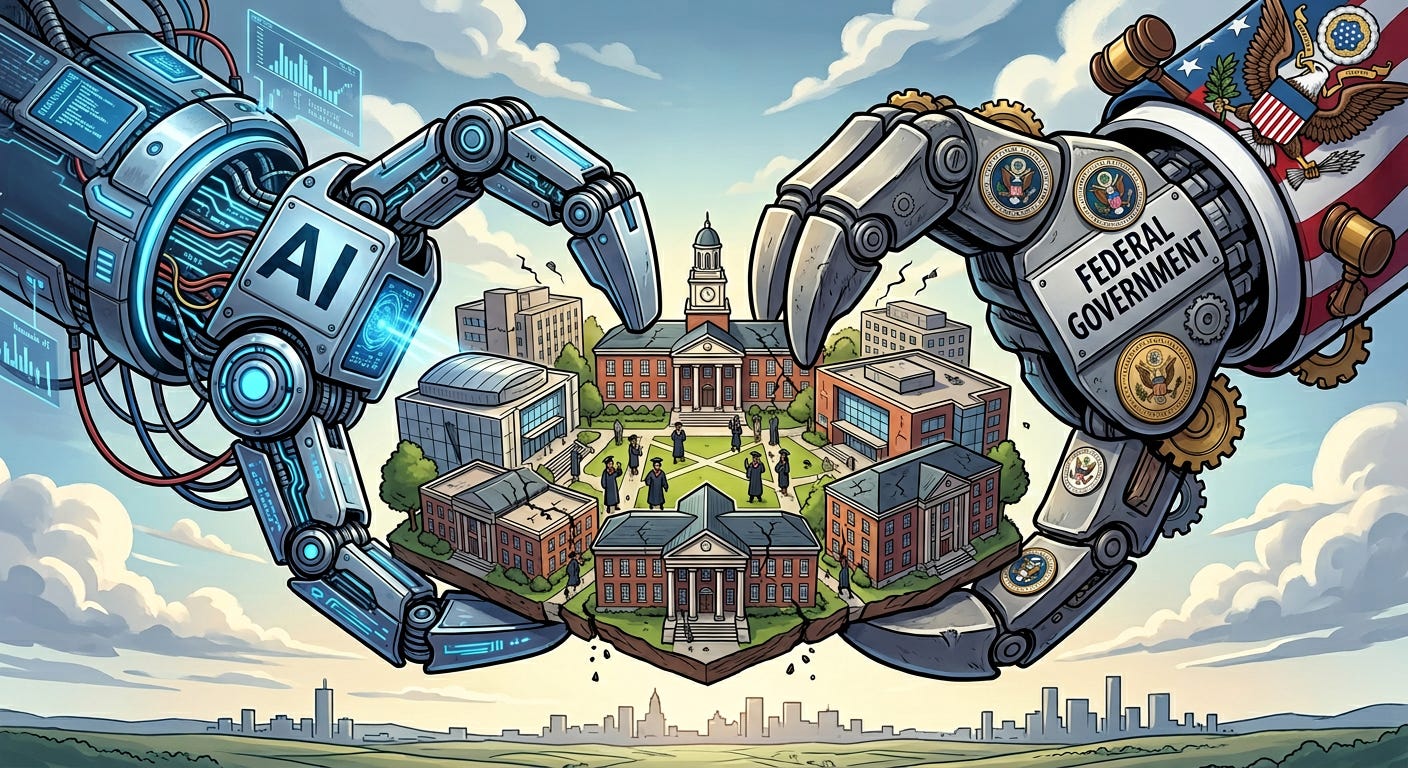
American higher education is caught in a pincer grip between the enormous power of the federal government and the rapid development of artificial intelligence. Either one of these challenges would be formidable if faced alone. Taken together, the pressures interact in ways that compound some of the threats but also open up some opportunities.
An additional challenge that has been building for some time, but which has only recently started to be addressed squarely, is a significant erosion of public trust in our higher education institutions. According to data from the Pew Research Foundation, 70 percent of Americans now say that US higher education is going in the wrong direction, up from 56 percent just five years ago. These trends cross party lines: disapproval is generally higher among Republicans but has also been rising sharply among Democrats.
A recent report by Yale that is worth reading has addressed some of the reasons for this, and the changes that would be needed to reverse the trend. I’ll discuss the report later but first want to take a step back and talk about the value that our higher education institutions continue to provide to the country.
A Jewel in the Crown
American higher education is a jewel in our economic crown. There is strong global demand for what our colleges and universities produce, with respect to both undergraduate teaching and the training of future scholars. We remain a magnet for talent from every corner of the world. But this competitive edge is now at some risk.
Much of what a foreign student spends while enrolled here is registered as an American export. This includes not just tuition and fees, but also expenditures on lodging, groceries, entertainment, domestic travel, and so on. Without this boost to our exports our trade deficit would be even larger than it currently is.

What we buy from the rest of the world, everything from clothing and apparel to furniture and consumer electronics, is for the most part financed either by our exports or by the accumulation by foreign nationals of claims against our future income. The sectors in which we have global competitive advantage—movies, music, professional sports, finance, consulting, pharmaceuticals, software, and higher education—are thus vital for our economic health.
It is important to maintain our leadership in higher education, and worth thinking about how we achieved it in the first place.
The Cold War and Hitler’s Gift
Two phenomena combined to accelerate our rise.
Vastly increased funding from federal agencies such as the NIH and NSF, motivated in part by cold war concerns, fueled the development of a powerful research infrastructure. This funding model involved high overhead rates, budgeted as indirect costs, that allowed for the financing of structures and equipment that could simultaneously serve a range of projects. But the fact that these overhead costs were transferable across projects and potentially used in ways that did not reflect federal priorities has made them a prime target for federal action. One of the first decisions taken by the current administration with respect to higher education was to drastically cut the ceiling on indirect cost rates.1
The second factor that led to our dominance was a massive brain drain from other countries, initially from Germany and to a lesser extent Italy, later supplemented by flows from other parts of the world.
In the early 1930’s, Germany and German-speaking parts of Europe were global leaders in higher education across a range of disciplines. The mathematics department at Göttingen was by far the best in the world, and perhaps the most impressive that has ever been assembled. Berlin, Heidelberg, and Vienna also had universities that were world leading at the time. The purge of Jewish faculty and political opponents by the Nazi government led to a collapse from which these institutions are yet to fully recover.
The large-scale movement of scholars to the United States and other countries has been described as Hitler’s gift. Among those who moved here were Albert Einstein, Max Born and Erwin Schrodinger in Physics, Hans Krebs in biology, Hannah Arendt in political philosophy, Emil Lederer in sociology, John von Neumann, Richard Courant, and Emmy Noether in Mathematics, Jacob Marshack and Albert Hirschman in economics, and Max Wertheimer in psychology.
I mention this because the loss of global leadership in higher education can be very rapid, and the risk we face is real.
I’ll illustrate with one example, but there are many like it. Ardem Patapoutian is a Lebanese-born molecular biologist who won a Nobel Prize for medicine in 2021. In February last year he had a major grant frozen by the NIH, and posted the news on social media. Within 24 hours, he had an offer from China for 20 years of guaranteed research funding at any university in any city of his choice.
China is not alone; many countries are seeing opportunities in this space. But at this point very few have the material resources and a credible commitment to academic freedom, and both are necessary to replicate the American model.
The Vance Vision
It should not have surprised anyone that the power of the federal government would be set in motion to make significant changes to US higher education following the 2024 election.
Certainly, anyone following JD Vance’s interviews and speeches would have heard him describe universities as an enemy that needed to be “taken over” or “destroyed” in order for a conservative vision for America to have any hope of success. These views were expressed with great clarity more than four years ago, well before the October 7 attacks, the war in Gaza, and demonstrations on campuses nationwide.
The federal government is clearly powerful enough to destroy even the most prestigious and well-endowed universities. I said so in writing back in April 2024, months before the presidential election, arguing that if we didn’t “abandon practices that expose us to legitimate criticism… centuries of tradition and mountains of amassed wealth will not save us from disaster.”
But this doesn’t mean that one should accept and comply with demands that are unreasonable or illegitimate. For example, surrendering autonomy over internal governance is a red line that I doubt any major university will cross. That said, there are indeed practices that expose us to legitimate criticism, and these are precisely the ones that have led to the erosion in public trust. The Yale Report provides some details.2
The Yale Report
The document identifies several reasons for the loss of support among the general public—soaring tuition and fees, lack of transparency in admissions, censorship and self-censorship on campus, political bias in the curriculum, and uncertainty about purpose and mission.
The holistic admissions process can be defended on meritocratic grounds, but can also be abused in the absence of transparency. Simple and clearly articulated rules would arouse less suspicion, even if they depart from individual measures of past performance.3 For example, Dartmouth recently abandoned its test-optional policy following a study showing that students from schools having lower levels of performance overall were withholding scores that would have raised their prospects of admission.
There is also a lot of evidence now that the holistic process favors families at the very top of the income distribution, whose probability of selection is higher conditional on standardized test scores.
According to the Yale report, “constructing a class will always involve judgment, and balancing across characteristics such as income distribution or regions of the country may be desirable. The question is whether that judgment can be exercised transparently and whether academic criteria remain visibly at the center.”
Or to quote Bowen and Bok from an influential book, “the freedom to exercise judgement in choosing candidates on the basis of criteria beyond the usual measures of earlier academic achievement carries with it an obligation to monitor the results of the admissions process,” including “graduation rates, academic performance, and subsequent contributions to society.” Universities have not met this obligation in any systematic and transparent fashion.
The Yale report also mentions “pressures toward conformity, intimidation, and social shaming.” Extensive survey data on self-censorship among faculty and students is published annually by FIRE, but an even more serious problem may be preference falsification, which gives the appearance of conformity.
Preference Falsification
A recent experiment involving undergraduates at Berkeley provides striking evidence of preference falsification.4 Students were randomly assigned to one of three treatments. Each group had to vote on a proposal that would be sent to senior administrators as a recommendation. The proposal was controversial: whether Berkeley should allow transgender women to compete in women’s collegiate sports. In one treatment student names would be listed alongside their votes. In another, only the list of voting students and the final outcome would be communicated, without identifying individual votes. The third treatment was novel: students could choose a threshold voting outcome such their identities would be revealed alongside their votes only if the voting threshold was met.
The results were striking. In the public treatment, students voted to allow transgender women to compete in women’s collegiate sports. In the anonymous treatment the vote was reversed. The threshold treatment matched the anonymous treatment, and one-third of students chose thresholds that allowed their identities to be revealed alongside their votes. Many students appear to vote sincerely and surrender anonymity as long as they feel that enough others will vote the same way.
Speech policies always involve a balance between harm avoidance and free expression. In my view, universities moved too far towards the norm of harm avoidance over the past decade. Good faith but politically unpopular arguments have been received as if they were abusive epithets.
Consider two examples.
Erica López Prater, an art historian at Hamline University, lost her job in 2023 for displaying an image of a painting that depicts the Prophet Muhammad receiving his first Quranic revelation from the Angel Gabriel. This 14th century painting is considered by many to be a masterpiece of Islamic art. Despite written and verbal trigger warnings, a student complained that the display in class was Islamophobic, and college administrators sided with the student.5
Dorian Abbot, a geophysicist at the University of Chicago, had a prestigious lecture cancelled by MIT because he had publicly opposed affirmative action. His views were sincerely held, close to a subsequent supreme court ruling, and completely unrelated to his research.
The AI Challenge
In closing, let me briefly address the challenge posed by the rapid development of artificial intelligence.
A year ago, most conversations on campus about AI had to do with threats to learning—students would fail to read assigned material, or submit assignments written with significant assistance from large language models. Their skills would thus atrophy, and they would be left unprepared for later life and careers.
But it has now become clear that those who fail to leverage the power of AI for complex tasks will achieve significantly lower levels of performance, not just in school but in their careers. That is, a student who avoids the use of AI throughout their education will be poorly prepared for later life, and will have been failed by their college or university. The problem of conventional skill atrophy is real, but it is also important not to pass up opportunities to develop new kinds of skills that can vastly increase what a student is able to produce.
Consider an example. Liam Price, A 23-year-old with no advanced mathematical training proved a 60-year-old conjecture by the mathematician Paul Erdős with the assistance of ChatGPT 5.4. While the model did the heavy lifting, there was considerable skill involved in understanding and posing the problem and in verifying the solution.
Colleges and universities have to find a way to prevent the atrophy of traditional skills while helping students acquire new competences that leverage the enormous and rapidly evolving power of artificial intelligence. Those students who focus only on maintaining and developing traditional areas of competence will be left far behind in most professions and graduate programs. They will have been let down by the institutions granting them degrees.
AI models are known to hallucinate—to make claims and generate citations that are completely invented. They also appear to seek approval, seldom contradicting or contesting user statements that have no basis in fact. This is seen as a weakness of AI models (which it is) but it also creates an opportunity for students to demonstrate a level of understanding that can filter out distortion and error.
My final point is this—if American colleges and universities can thread the needle and solve the problem of teaching students to leverage the power of AI without losing the traditional skills that have been built and valued in the past, they may be able to retain their standing atop the global higher education hierarchy despite the significant headwinds they currently face.
This is the silver lining in our present cloudy reality.
The legal and political status of these caps remains unresolved.
For a somewhat different perspective on the report than the one offered here, see Shikha Dalmia’s thoughtful post.
The construction of a meritocratic selection policy does not simply involve rewarding past performance as embodied in scores, as a recent paper by Steven Durlauf explains.
For another example, consider a pair of votes of no confidence in Dartmouth’s president, one public and one anonymous.
A settlement has now been reached in this case.