
Guns + Violence

Jens Ludwig is a founder and director of the Crime Lab at the University of Chicago and the author of a recent book Unforgiving Places: The Unexpected Origins of American Gun Violence. He appeared a couple weeks ago on Glenn Loury’s podcast (in an episode co-hosted by John McWhorter) to discuss the book and his work over the past three decades on crime and policing.1
There are more guns in America than people, and this is unlikely to change anytime soon. But this doesn’t mean that gun violence lies outside the scope of feasible public policy initiatives. Ludwig argues that gun violence ought to be understood as guns plus violence and that much can be done to reduce the latter even while the former is relatively resistant to policy.
However, he feels that the problem of gun violence has been misdiagnosed and that “a mindset shift and course correction” is needed. In making his case, he takes interesting detours into the work of Daniel Kahneman on thinking fast and slow, William Julius Wilson on the selective depopulation of inner city neighborhoods, Jane Jacobs on eyes on the street, and even the hotly debated (and arguably misunderstood) article by George Kelling and James Q. Wilson on broken windows.
In Ludwig’s view, there are two prevailing narratives regarding the drivers of interpersonal violence, neither of which is adequately supported by evidence. On the political right, violence is attributed to “immoral people who are unafraid of the criminal justice system.” The only solution from this perspective is greater certainty and severity of punishment. On the left, violence is attributed to “economic desperation… people who are trying to feed themselves, feed their families.” This suggests that little can be done about violent crime unless poverty is first alleviated.
These narratives are worlds apart but they involve “an implicit agreement that before anybody pulls a trigger, they're engaging in some sort of deliberate weighing of pros and cons.” Ludwig disagrees. Rational deliberation and cold calculation may be relevant for property crimes, he argues, but violence results from decisions that are far more impulsive and spontaneous.2
Even impulsive actions, however, can be subject to analysis and intervention. Here Ludwig draws on Daniel Kahneman’s distinction between system 1 (fast) and system 2 (slow) thinking. Crimes such as burglary, larceny, and motor vehicle theft involve thinking slow, and might be responsive to policies that change costs and benefits relative to other activities. But gun violence is different. Ludwig argues that for the most part, this arises not from gang wars over turf or robberies gone awry, but from the escalation of disputes over relatively trivial matters.3 The adoption of incentive-based policies to deal with such situations is like “trying to cure cancer with heart disease medication.”
Slow thinking is extremely powerful but mentally taxing. As a result, “our minds have evolved to do a different type of thinking… below the level of consciousness, a series of automatic responses that are fast, effortless, and adaptive… useful for routine things that we see over and over again in our daily lives.” These responses are tuned to the situations that we encounter with high frequency. In environments where mechanisms of formal and informal social control have become overwhelmed, thinking fast can result in escalating violence as a self-protective measure. He illustrates with an example:4
I’m a kid growing up in Englewood… I'm walking to school and someone challenges me for my lunch money in a neighborhood where... I can't turn to an adult for help. My system one… learns pretty quickly that if I hand over my lunch money today, I've just signaled to everybody else in the neighborhood that I'm an easy victim. You take my lunch money today, tomorrow you're coming back for my jacket, the next day you're coming back for my phone… It's over for me… When I'm challenged, that's a routine situation I see over and over again. I fight back. And notice the severity of the fightback need not be proportional to the provocation because it is not backward looking retribution to what you just did to me. It is forward looking signaling to everybody else in the neighborhood.. And that leads to what from the outside can look like overreactions when those responses are overgeneralized, including when someone's got a gun, when someone's got a knife.
The implication is that public policy will be most effective if it focuses on the interruption rather than the deterrence of violent behavior. How might this be done?
Ludwig argues that his thinking on this question “was shifted kicking and screaming by a bunch of really clever insights and observations that nonprofits and frontline government workers had about the problem.” For example, he (and collaborators) examined the effects of Becoming a Man (BAM), a violence interruption program run by a Chicago nonprofit. This effort has reached ten thousand adolescents over the past decade and has been found to yield significant benefits relative to costs:
Notice what that program is not doing. It's not ending poverty. It is not threatening people with stiffer punishments. What it is doing is… getting kids to be a little bit more skeptical of whatever system one fast thinking is putting into their heads to get them to be a little bit more system two and deliberate in these sort of high stakes moments that lead to violence. So you're like well that truly can't work. We did a randomized experiment just like they do in medicine and we used police data to measure violent crime arrest rates for kids. So we're not relying on kids self-report so you worry that they're lying to you. We see a 50% reduction in violent crime arrests. Also a reduction in arrests for weapons offenses. That's comparing people who went through the program with those who did not… Now, whether that would work if you give it to a million kids is an open question, but as proof of concept of what is driving the behavior, I don't see how you can look at that evidence and not be moved off of your original conventional wisdom position.
Are such efforts scalable? Ludwig argues that focused implementation in schools and detention centers might be all that is required:
There's more scalability here than you might think… if you look at data from the Chicago Police Department, 90% of the offenders for murders in Chicago and 80% of the victims have an arrest record… almost everybody involved in gun violence in Chicago has passed through the criminal justice system. We in principle had a chance to do something developmentally productive with them to make their lives better and we blew it.
One BAM-like intervention in the Cook County Juvenile Temporary Detention Center was found to reduce readmission rates to the facility by 21%, again based on a randomized controlled trial. Ludwig argues that such reductions can be achieved essentially without cost, and argues for implementation “in every juvenile detention facility and every jail and every prison.”
He also argues for similar interventions in high schools, where more time in health education classes should be spent on the most serious threats to the life of American adolescents—homicide, suicide, drug overdoses, and car crashes.
Violence interruption programs are one approach to reducing gun violence; urban revitalization is another. Here Ludwig leans on the work of William Julius Wilson and Jane Jacobs. Wilson argued that “starting in the mid-60s, middle class black families moved out of the inner city as housing discrimination started to attenuate. And that led to an important source of neighborhood resource to collapse… This is eyes on the street. This is informal social control.” Eyes on the street, according to Jane Jacobs, explained why neighborhoods with comparable levels of poverty had such different levels of crime.
Ludwig argues that this explanation “makes no sense under conventional wisdom… If it's bad people or poor people, what good is an eye on the street going to do? You're just… going to wait for the eyes on the street to go around the corner… It's only the behavioral economics perspective that gives you a way to understand why the motivation for violence is fleeting. Why violence interrupted is violence prevented rather than merely violence delayed.”
He illustrates these ideas with his own experience in Chicago:
I lived in Hyde Park on the South Side for 18 years. You drive around the South Side, you can see there are churches that clearly were once in much better condition and better resourced than they are now… the Woodlawn neighborhood just south of Hyde Park on the South Side of Chicago had a stretch of nightclubs where world famous performers would perform… now totally gone. Woodlawn is another one of these neighborhoods that has lost 50-60-70% of its population since the mid 1960s… Jane Jacobs argued for things that would get pro-social adults out of their homes into public spaces so they could help intervene and deescalate things. Really hard to do when a ton of your houses are abandoned. A bunch of your lots are overgrown with weeds. There are used condoms, empty heroin baggies, needles… that is not the sort of place that people want to go out in the public for.
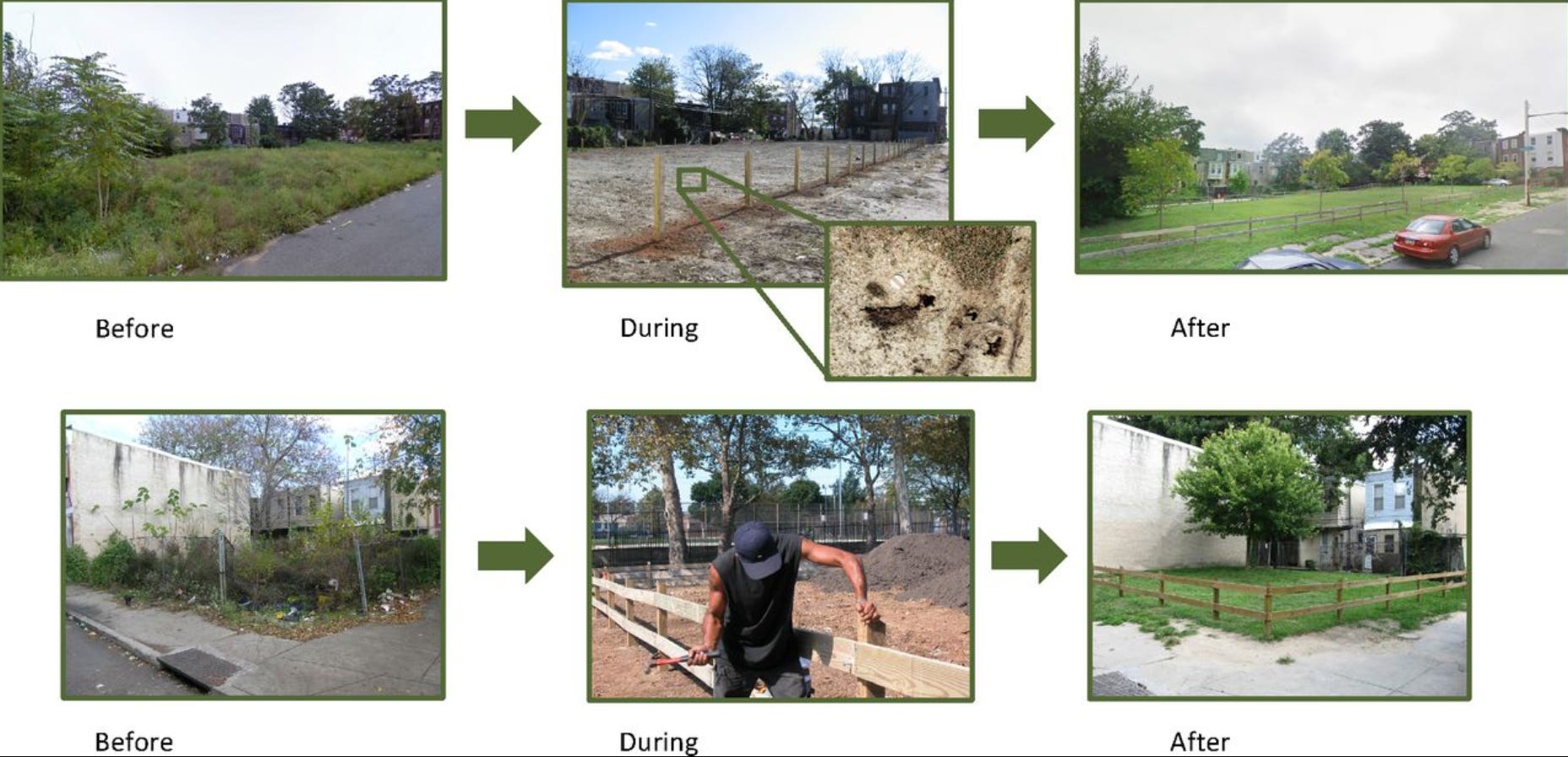
You can see this in the data… researchers from the University of Pennsylvania worked with the city of Philadelphia to randomly pick some vacant lots to clean up and others not… neighbors now are much more willing to go out in the public and in low income neighborhoods, shootings go down by something like thirty percent in the vicinity of those scary vacant lots turned into pocket parks compared to similarly scary places that weren't fixed up. Thirty percent fewer shootings. That is not a small effect.5
This led to the following very interesting exchange between Ludwig (JL) and Loury (GL):
JL: We can zone commercial in with residential. We can make the built environment inviting enough so it has an actual lively social environment so there are adults around to step in and deescalate. There are lots of experiments that show that you improve street lighting, you get people out on the street, shootings go down. You fix up abandoned houses, people come out, shootings go down. You open stores in neighborhoods where there are not many stores, shootings go down.
GL: So this is James Q. Wilson, isn't it? This is broken windows?
JL: It's a great question. I have a friend who was very high up at NYPD and he said to me once I think we at NYPD gave the broken windows idea a bad name. We did zero tolerance policing where we were just arresting everybody for every minor thing, but there are other ways to fix broken windows like fixing broken windows.
GL: Right… I was about to say I wasn't talking about policing methods. I was talking about environmental amenities and the indirect effect of that on something like violence, which you wouldn't necessarily automatically think of.
JL: The broken windows term has become associated with zero tolerance policing, but it need not be.
This exchange jumped out at me because I had heard something very similar from Elizabeth Glazer at an Arnold Ventures BRIDGE event just a couple of months ago. Glazer had suggested to the audience that public debate around the broken windows article had distorted its message and that we should all go read it once again. So I did. And, indeed, the article really is about the importance of foot patrol as a source of paid eyes on the street, and the authors are quite explicit about the possibility that this role may be played by “agencies other than the police.”
I began this post with the claim that gun ownership rates are likely to remain extremely high in the United States. For better or worse, we are not going to see restrictions of the kind implemented by Australia following the Port Arthur massacre. Fortunately, the correlation between gun ownership and gun homicides at the state level is weak.6 Furthermore, there have been dramatic changes over the past few years in the incidence of fatal and non-fatal shootings, even as overall gun prevalence has remained relatively stable. These changes are consistent with the violence interruption and eyes on the street perspectives.
That said, a significant share of crime guns originate as thefts or straw purchases. Gun trafficking is a System 2 activity and responsive to incentives, and there may be civil remedies that could encourage safe storage in ways that are acceptable to many legal gun owners.
Ludwig refers to himself as a “pathological pragmatist” who thinks that his proposed solutions could have broad appeal across the political spectrum. Behavioral interventions in juvenile detention centers and the cleaning and greening of vacant lots are policies that sidestep “big political fights… in this hyperpolarized moment.” He points out that the murder rate declined by nearly 80% in Los Angeles and 90% in New York during the three decades following its peak in 1991, in part because of data-driven policing that put “paid eyes on the street in those places where gun violence is most likely to to happen” and were “early and rapid adopters of… community violence intervention” initiatives.
But these practices were bundled with others that imposed significant costs with no discernible gains in reduced violence. Reported annual pedestrian stops under the relatively permissive “reasonable suspicion” standard established in Terry v. Ohio reached a peak of almost 700,000 in 2011 before dropping precipitously following a court ruling and a change in administration. By 2014 the number of stops had fallen by more than 93 percent from the peak, and by 2016 stops were down 98 percent. But the calamity that was predicted in some quarters simply failed to materialize. And one recent study using precinct level data found no measurable impact of the dramatic curtailment of street stops on violent crime.
This illustrates both the power and the limitations of randomized controlled trials. Actual policy initiatives are a multidimensional package spanning many different measures. Some may be highly effective, while others are neutral or perhaps even counterproductive. The effects we see in observational data are aggregate effects, summing across all components of the policy regime in place. Randomized trials allow us to isolate causal effects along one or two dimensions, while the others are part of the background. This limits the applicability of the findings to environments in which these background factors are not too different.
So, for example, the effects on violence of cleaning and greening vacant lots may be quite sensitive to certain environmental factors such as population density, the intensity of foot patrols, initial levels of interpersonal violence, the attitude of rank and file officers to the police chief or mayor, the level of cooperation between residents and law enforcement officers, and even the mean daily temperature. A study conducted in Philadelphia today may not be very informative about the effects of a policy intervention in Phoenix next year.
Researchers like Ludwig understand these issues with external validity, of course. For instance, you would not want to test a new drug or vaccine on a very specific subset of the population, such as young men, because it would limit your inferences about its risks and effectiveness more broadly. But with social science research we are often limited to very specific subsets of the population. Some skepticism about the broader applicability of such studies is accordingly warranted. I mention this only because the issue was not raised during the episode (I'm sure it's discussed at length in the book).
That said, the arguments presented are extremely compelling and the entire conversation is worth your time.
This distinction between crimes that involve cold calculation and those that occur in the heat of passion is useful but glosses over the fact that most crimes involve multiple stages, each of which has a different character. Reacting violently when resisted by a robbery victim may be impulsive, but victim selection itself involves careful deliberation. Discharging a firearm in the face of a perceived threat may by spontaneous, but weapon selection and acquisition are calculated acts. These and other examples are discussed in my book with Dan O’Flaherty.
In our work on Newark, Dan O’Flaherty and I also found that while “many victims and perpetrators are members of some sort of gang… formal gang wars account for only a small proportion of murders.” Along similar lines, Ludwig argues that even when parties to violence happen to be in different gangs, this fact is often “incidental to the shooting.” This feature of interpersonal violence is not unique to the United States. Alejandro Gaviria found that in Colombia in the 1980s, despite the widespread presence of drug cartels and paramilitary organizations, more than four in five homicides were “the manifestation of an amorphous violence not directly related to a few major criminal organizations.”
In quoting from the transcript, I have dropped fillers such as kind of, you know, like, and um and occasionally added italics to emphasize key points.
I believe that the study being referenced here is by Branas et al. (2018).
In contrast, the correlation between gun ownership and gun suicides at the state level is extremely strong, and data on gun suicides are sometimes used as an input to estimate the prevalence of gun ownership.
Compelling research and write up. I’d also recommend Josiah Bates’ book from last year, In These Streets. Josiah is a very thoughtful journalist. His book comes to some similar conclusions but without the economic underpinnings. The book has a number of great interviews with just about every group affected by gun violence - activists, social workers who intervene in dangerous situations with people on the streets, victims, families of victims, police, public health academics, and even shooters. It’s a good short read. Josiah recently left New York and is now covering gun violence in the Midwest for The Trace. https://www.thetrace.org His writing is worth following.
Thank you Troy, I'll definitely take a look